

How I Built the Most AI-Pilled Company in the World
Article URL: https://x.com/jsnnsa/status/2115623382721126826?a=fjiH4cVowfsIKfO0urI&s=46 Comments URL: https://news.ycombinator.com/item?id=50299051 Points: 1 # Comments: 1
jacob
@jsnnsa
How I Built the Most AI-Pilled Company in the World
17 min read
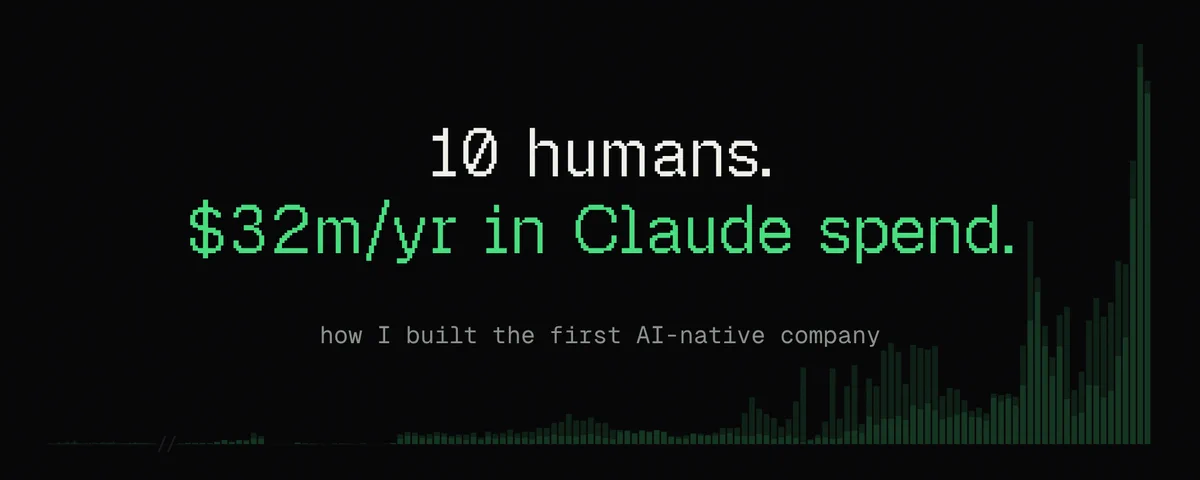
Spawn is ten people. We spend 30x payroll on AI tokens and ship almost as much as Anthropic.In the last 30 days, Spawn shipped 77,000 substantial changes. That's about 108 an hour, around the clock. We're a team of ten.
If this sounds far from how your team works, it is. No better time than the present. See you out there!The work is done by what we call the fleet, a team of permanent AI agents that each own a part of the company, from the engine to finance to bug triage. We spent $3.1 million on tokens last month, which makes us one of Anthropic's biggest customers. Even without the free Opus 5.5 we give our creators, we'd still be in their top 250.
My first thought was that we were doing something wrong. So I had chats with some of my friends who run the biggest companies and startups to figure out how we could possibly be spending more than them. We weren't doing anything wrong, we just think about AI very differently. Most companies run big human teams that use AI, and we run a small human team alongside a big team of agents. To figure out what we were doing differently, I compared notes with a researcher at Anthropic. They talk to a lot of customers. They said Spawn is the one that works most like Anthropic.
A lot of other founders wanted to understand how we think about this, so I've collected my ideas and learnings from the last year and written them down here for you.
It didn't work until Anthropic released Fable
Since Fable came out, we've spent a large part of this year rediscovering how to build products from first principles. We now ship 500x more than we did 6 months ago.
To give you an idea of the scale I'm talking about, we shipped 77k (substantial) changes to players in the last 30 days. That's an average of 108/hr to players. We spent $3.1 million on tokens to do it.
Most people run agents in Claude Code, short-lived and focused on one task. Ours are different, and we call them the fleet. Each one is permanent, has a name and a memory of what it has done, has real permissions in our systems, makes commitments, and owns an area of the company like the engine, Savi, ops, finance, bug triage or deploys. Each uses swarms of helper agents to get through a massive amount of work, and most days the fleet births 1,000s of them. The five of us also work with our modified Claude Code directly, on bigger, more ambitious projects that need closer steering or hands-on experimenting.
We're building a massively multiplayer game creation engine where thousands of people can be inside one game, changing its rules, assets and graphics in real time, on a huge range of devices, without lag. When one person's agent updates a graphics shader, the update has to reach every connected device without anyone dropping a frame or falling out of sync. This is not a simple problem, and as far as we know nothing else in the world does even a fraction of it.
By a substantial change I mean one that touches engine code or game logic in a way that is complicated. Not a little HTML change. Not a dial turn. Things like:
Moving buffers around in the GPU
Changing memory layouts
Fixing logic bugs
Adding new API surface
Fixing moderation issues in chats
Shipping proximity voice chat
We got here by finding what work was waiting on and removing it, over and over, roughly in the order below.
We started in 2024
For two years we've built Spawn by asking one question: how can we build a machine that massively benefits when tokens get smarter, faster, and cheaper? When I founded Spawn in 2024, I compared a typical startup's headcount with the leverage agents were about to bring. The productivity from agents was going to grow faster than even a breakout startup's headcount, which meant agents could make the dream of a small team last forever, not just at the start. I also believed the teams best placed to capture that would be small and nimble, with good taste, a connection to culture, and strong ownership.
We didn't wait for the models to start building the company this way. We've recorded every call since our founding, and each one went into a file in our code repo, next to the code, because we knew one day it would be great context for agents.
For most of those two years the bet didn't pay. We tried tons of models and they were just too stupid. They mucked things up badly. That's the flat part of the chart.
This whole way of working only became possible with Fable. It came out on June 9. Two days later we landed 214 changes in a day. On June 12 an export control order suspended access to it, and the chart drops to nothing until access came back on July 1. As of today, no other model can do this, not even Opus 5.5, which is otherwise extremely capable.
Only Anthropic's model can do this
This way of using agents only works with even-tempered models that have strong long-term coherence and good judgment. We've tried frontier models from Anthropic, OpenAI, Google, xAI and open source, and nothing outside of Fable has worked. Trust me, I'd love to use a cheaper model, but Anthropic's are the only ones that don't cause literal disasters.
I asked GPT Astra to secure Spawn. It went through all of our features, found the security issues, and made a list of fixes. They looked good, so I told it to go do them and let it ship the change on its own. Then I w
ent to test it and nothing worked. I couldn't create a game. I couldn't play a game. I couldn't sign up.
I asked the fleet what happened. Every feature had been disabled and marked to be turned on again once the security fixes were done. Astra had gone through our whole product and made the insecure things secure by turning them off. Every moment an agent works at Spawn, it has to make good judgment calls about the information it's receiving, the actions it's taking and its own environment. Behavior like this would cause significant disruption and likely destroy the product.
In general, we've seen



Nguồn tin: Hacker News AI — Tác giả: tangled. Bản dịch tiếng Việt do AI thực hiện, có thể có sai sót.